Working Capital Loans in Singapore

Head of Research
|
Updated 06 May 2026
|

Fact-checked

Disclosure

Glossary

Useful Resources

Head of Research
Updated 06 May 2026
|

Fact-checked

A working capital loan provides financing for day to day business operations such as payroll, rent, utilities, inventory, supplier payments and other recurring expenses. Unlike term loans used for expansion or asset purchases, working capital loans address the cash flow gaps that occur between paying expenses and receiving revenue. 

In Singapore, SMEs can access working capital financing through the government backed Enterprise Financing Scheme (EFS-WCL) offering up to $500,000 with 50% to 70% government risk sharing furthermore major banks and alternative lenders also offer working capital loans  This page explains how working capital loans work, compares options and covers related financing like invoice financing and business lines of credit that also serve operational cash flow needs.

More Details

Working capital is the cash a business needs to fund daily operations, basically the gap between current assets such as cash, receivables, inventory and current liabilities such as payables or short-term debt. A working capital loan provides funds specifically to cover this gap, ensuring the business can pay staff, suppliers and overheads while waiting for customers to pay.

  • Payroll and employee related costs
  • Rent, utilities and office expenses
  • Inventory purchases and restocking
  • Supplier and vendor payments
  • Tax obligations and statutory contributions
  • Marketing and operational costs
  • Seasonal business fluctuations
  • Bridging receivables gaps
  • EFS-WCL (Government-backed): Up to $500,000
  • Bank working capital loans: $50,000 to $500,000
  • Digital lenders: $10,000 to $1,000,000
  • Invoice financing: Up to 80 to 90% of invoice value
  • Amount depends on annual revenue, cash flow patterns and existing debt. Most banks lend 10% to 30% of annual turnover for working capital.
  • Approval speed varies significantly by lender type:
  • Digital lenders: Same day to 3 working days
  • Traditional banks: 3 to 14 working days
  • Government-backed schemes: 3 to 7 working days for provisional approval
  • Secured loans (property/
    equipment):
    10 to 21 working days due to valuation
  • Over 85% of EFS applications from eligible SMEs received provisional approval within 3 working days.
Purpose
Operational cash flow
Growth, expansion, assets
Structure
Can be revolving or term
Fixed lump sum
Tenure
1 to 5 years (often shorter)
1 to 7 years
Repayment
Flexible or fixed
Fixed monthly instalments
Amount
Based on cash flow needs
Based on project/purpose

Disclosure

Glossary

Useful Resources

img
Government Support

EFS-WCL provides 50% to 70% government risk sharing through Enterprise Singapore, improving approval chances for eligible SMEs.

img
Up to $500,000

Borrow up to $500,000 under EFS-WCL. Bank and alternvative lender limits vary based on revenue and creditworthiness.

img
Typical Rates

EFS-WCL rates range 7% to 10% p.a. EIR depending on bank assessment. Alternative lenders charge 9% to 15% for faster approval.

img
Flexible Options

Choose term loan for fixed payments), revolving facility draw as needed or invoice financing tied to receivables.

Our Expert says

Working Capital Is About Cash Flow Timing Not Profitability

A profitable business can still fail from poor cash flow management. You invoice $100,000 in sales but customers pay in 60 to 90 days while rent, payroll and suppliers are due now. This timing mismatch is exactly what working capital financing solves. The key metric is your cash conversion cycle, basically how long it takes to turn inventory and receivables into cash. If that cycle is 90 days but your payables are due in 30 days, you have a 60 day funding gap. 

My advice, size your working capital facility to cover this gap not your total expenses. And choose the structure that matches your cash flow pattern. A term loan for predictable needs, a revolving facility for fluctuating needs or invoice financing if receivables are your main bottleneck. Quote Icon

Trinh Thanh
Trinh Thanh
Head of Research
img

Eligibility Requirements

Working Capital Loan Eligibility

EFS-WCL Requirements:
check-icon
Singapore-registered business (ACRA)
check-icon
At least 30% local shareholding (SC/PR)
check-icon
Group annual turnover of less than $100 million OR less than 200 employees
check-icon
Operating for minimum 1 to 2 years
check-icon
Satisfactory credit profile for business and directors
check-icon
Positive cash flow or clear path to profitability
Bank Commercial Products:
check-icon
Singapore-registered business
check-icon
Minimum 6 months to 2 years operating history
check-icon
Minimum annual revenue $100,000 to $300,000
check-icon
No local shareholding requirement
check-icon
Personal guarantee from directors
Digital Lenders:
check-icon
Singapore registered business
check-icon
Minimum 6 months operating history
check-icon
Minimum annual revenue $100,000
check-icon
Active bank account with transaction history
check-icon
Less stringent credit requirements
Documents Required:
ACRA BizFile (business profile)
NRIC copies of directors/shareholders
Latest 6 to 12 months bank statements
Latest 2 years financial statements
Latest Notice of Assessment from IRAS
Accounts receivable/payable aging for invoice financing

Tips for Business Loan Applicants

Tips to Improve Approval Chances
Show consistent revenue

Banks want to see stable, predictable income. Provide 12 months plus of bank statements showing regular deposits. Avoid applying during your weakest revenue months.

Demonstrate positive cash flow

Even if profits are thin, it shows that cash is flowing through the business. Net positive bank balances month-over-month signal healthy operations.

Clean up receivables

If applying for invoice financing, ensure your receivables are from creditworthy customers with consistent payment history. Disputed or aged invoices reduce financing value.

Right size the facility

Banks assess whether the facility size is proportionate to your revenue and realistic to service.

Consider EFS-WCL first

The government risk sharing significantly improves approval odds especially for businesses that might be marginal on standard commercial criteria.

Apply with your transaction bank

The bank where you maintain your business account has visibility into your cash flows. This transaction history supports your application better than applying to a new bank.

List of Working Capital Loans in Singapore

All banks listed are regulated by MAS. Compare rates and
launch your application directly via ROSHI.
Loan amount must be between 500 and 100,000.
Tenure must be between 1 and 60 months.
More Filters
ROSHI Business Loan Promotion
22.56%
10%
$1,021.33
$2,256.00
6.5 %
1%
$887.50
$650.00
6.5 %
1%
$887.50
$650.00
7 %
1%
$891.67
$700.00
7 %
1%
$891.67
$700.00
7 %
1%
$891.67
$700.00
7.75 %
1.5%
$897.92
$775.00
7.88 %
1%
$899.00
$788.00
9.75 %
1.5%
$914.58
$975.00
12 %
7%
$933.33
$1,200.00

All lenders verified against Ministry of Law registry. Last updated: June 12 2026.

Working Capital Financing Options

Different structures serve different cash flow patterns.

img
EFS Working Capital Loan
Interest Rate: 7% to 10% p.a. EIR
Government-backed term loan through Enterprise Singapore's Enterprise Financing Scheme. 50% to 70% government risk-sharing improves approval chances. Fixed monthly repayments over 1 to 5 years. Requires 30% local shareholding. Available through 19 participating banks including DBS, OCBC, UOB and Standard Chartered.
Best for:
SMEs needing up to $500,000 with government support.
img
Business Line of Credit
Interest Rate: 8% to 12% p.a.
Revolving facility allowing you to draw funds as needed up to a pre-approved limit. Pay interest only on the amount used. Repay and reborrow without reapplying. More flexible than a term loan for unpredictable operational needs. Available from most banks and some digital lenders.
Best for:
Fluctuating cash flow needs.
img
Invoice Financing
Interest Rate: 1% to 3% per invoice
Convert outstanding invoices into immediate cash and receive up to 80 to 90% of invoice value upfront, balance when customer pays. No fixed monthly payments; financing tied to receivables cycle. Available from banks (OCBC, DBS) and alternative lenders (Funding Societies, Validus, GXS Capital).
Best for:
B2B businesses with 30-90 day payment terms.
img
Payroll Financing
Interest Rate: 1% to 2% per payroll cycle
Specific working capital facility to cover salary and CPF obligations. Ensures staff are paid on time even when customer payments are delayed. Often structured as a short term facility aligned with payroll cycles. Available from select lenders and some staffing agencies.
Best for:
Businesses with high staff costs and delayed receivables.

Enterprise Financing Scheme (Working Capital Loan)

The government backed option with risk sharing to improve approval chances.

Risk Sharing Mechanism
The EFS-WCL is the most widely used government financing scheme for SME operational needs. Enterprise Singapore shares 50% to 70% of the default risk with participating banks encouraging them to lend to businesses that might otherwise be rejected.
Eligibility Requirements:
  • Business registered and operating in Singapore (ACRA).
  • At least 30% local shareholding (Singapore Citizens or PRs).
  • Group annual turnover less than $100 million or less than 200 employees.
  • Satisfactory credit profile for business and directors.
Participating Banks (19 institutions):
DBS, OCBC, UOB, Standard Chartered, Maybank, CIMB, RHB, HSBC, Bank of China, ICBC, Hong Leong Finance, Singapura Finance, and others.
Key Features
Maximum Loan
$500,000 per borrower
Tenure
Up to 5 years
Interest Rate
7% to 10% p.a. EIR determined by bank
Government Risk-Share
50% standard;
70% for young enterprises less than 5 years
Collateral
Unsecured but personal guarantee required
Processing Time
3 to 7 working days for provisional approval
How to Apply
Check Eligibility Review basic criteria on the Enterprise Singapore website.
Prepare Documents Assemble ACRA BizFile, financial statements, and recent bank statements.
Submit Bank Application Apply directly through a participating bank's SME portal.
ESIMS Integration The application is processed via Enterprise Singapore's Incentive Management System.
Provisional Approval Receive your initial lending assessment within 3 to 7 working days.
icon EFS enhancements took effect 1 April 2026 as announced in Budget 2026. Verify current terms at enterprisesg.gov.sg.



Who Provides Working Capital Loans in Singapore?

Three main lender types, each come with different rates, requirements and approval speeds.
Banks (via EFS-WCL or Direct)
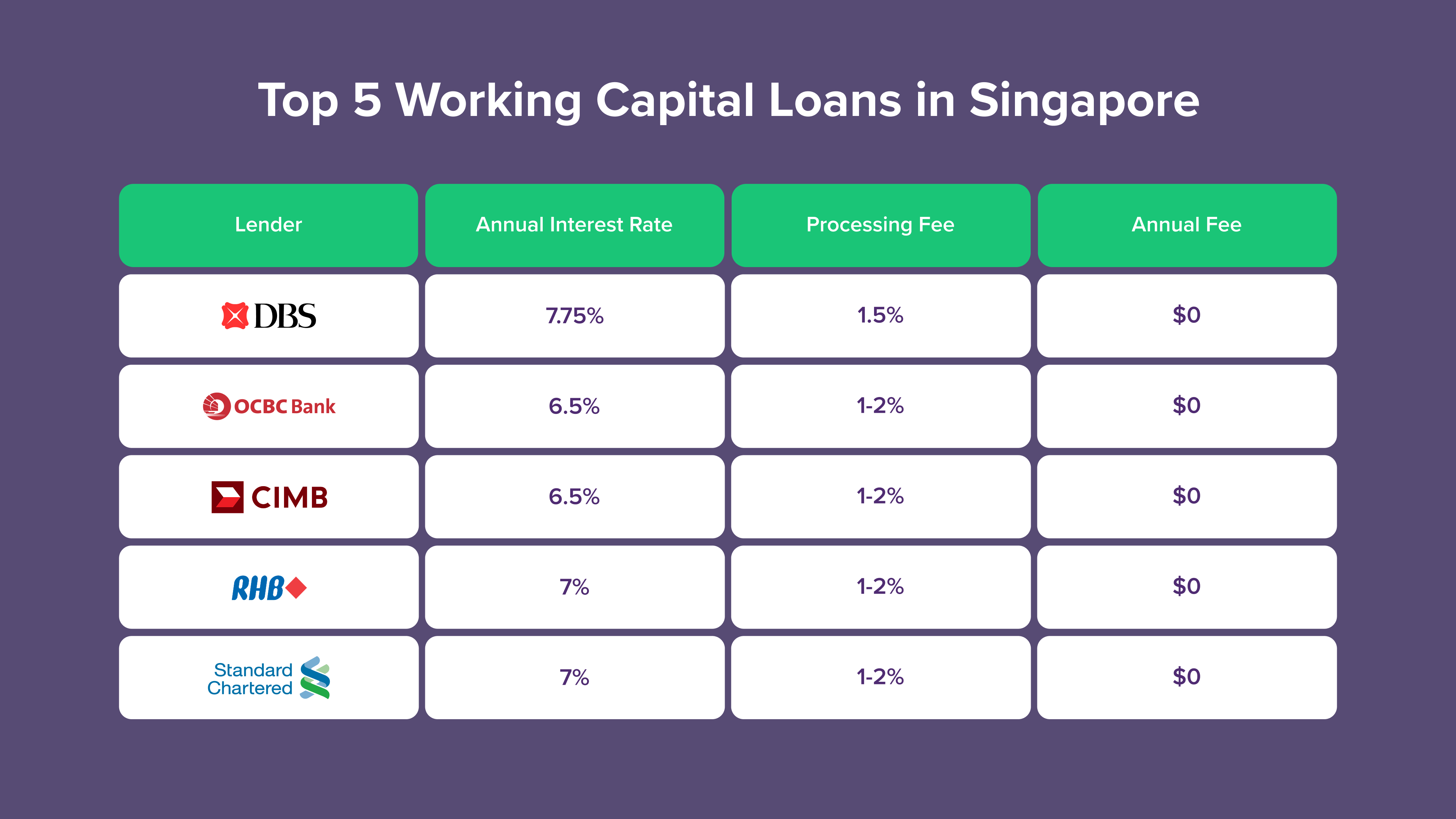
Interest Rate: 6.8% to 11% p.a. (EIR)
Major banks offer working capital loans both through EFS-WCL and direct commercial products. EFS-WCL requires 30% local shareholding; direct products don't. Banks include DBS, OCBC, UOB, Standard Chartered, Maybank, CIMB, and RHB. Minimum 1 to 2 years operating history and $100,000 to $300,000 annual revenue typically required.
Best for:
Established SMEs seeking lowest rates especially if eligible for EFS-WCL.
Licensed Moneylenders
Interest Rate: 12% to 48% p.a. (capped at 4% per month)
For businesses that don't qualify for bank or alternative loans with limited history, poor credit or urgent needs. Same day approval and disbursement available. Higher rates but most flexible approval. Useful as a bridge while securing longer term financing.
Best for:
Urgent short term needs or businesses rejected by other lenders.
Alternative Lenders
Interest Rate: 9% to 15% p.a. (EIR)
Platforms like Funding Societies, Validus (GXS Capital) and ANEXT Bank offer faster approval, often between 24 to 72 hours with less stringent requirements. Accept businesses from 6 months old. Offer term loans, invoice financing and revolving facilities. Fully digital applications with minimal documentation.
Best for:
Younger businesses, urgent needs or businesses who don't meet bank criteria.

When to Use Invoice Financing Instead

If receivables are your bottleneck, invoice financing may be more efficient than a term loan.
Working Capital Term Loan Invoice Financing
StructureFixed amount, fixed repaymentTied to specific invoices
InterestCharged on full loan amountCharged only on invoices financed
RepaymentMonthly over 1 to 5 yearsWhen customer pays invoice
FlexibilityFixed facilityScales with sales volume
Best forPredictable ongoing needsBusinesses with long payment terms
ProvidersBanks, digital lendersOCBC, DBS, Funding Societies, Validus
Choose Invoice Financing If
Your customers are creditworthy but pay in 60 to 90 days
You have consistent B2B invoices each month
You want financing that scales with sales
You prefer not to commit to fixed monthly repayments
Choose a Term Loan If
You need funds for multiple purposes beyond receivables
Your cash flow needs are predictable
You prefer fixed repayments for budgeting
You don't have consistent invoice volume

How To Apply for a Working Capital Loans

Calculate your working capital needs
Assess your cash conversion cycle: how long between paying suppliers and receiving customer payments? Size your facility to cover this gap plus a buffer for unexpected delays.
step-icon
Check EFS-WCL eligibility first
If you meet the 30% local shareholding requirement, EFS-WCL offers the best rates due to government risk sharing. Check eligibility at enterprisesg.gov.sg.
step-icon
Prepare documentation
Gather ACRA BizFile, financial statements, bank statements and NOA. For invoice financing also prepare AR aging reports showing outstanding invoices.
step-icon
Compare multiple options
Request quotes from 2 to 3 banks and alternative lenders. Compare EIR, fees and flexibility. Consider whether term loan, revolving or invoice financing best matches your cash flow pattern.
step-icon
Submit application
Apply directly via ROSHI or through bank's SME portal, ESIMS for EFS-WCL or digital lender's platform.
step-icon
note Pro Tip:
Apply to your primary business banking relationship first, existing customers often receive faster approval and better rates.

What Are the Pros & Cons of Working Capital Loans?

PROS

  • Keeps operations running smoothly during cash flow gaps
  • EFS-WCL offers government risk sharing for easier approval
  • Multiple structures available such as term, revolving and invoice based
  • Lower rates than credit cards or overdraft facilities
  • Build business credit history for future financing
  • Interest may be tax-deductible

CONS

  • Personal guarantee puts directors' assets at risk
  • Monthly repayments impact cash flow even during slow periods
  • Doesn't address underlying cash flow management issues
  • EFS-WCL requires 30% local shareholding
  • Digital lenders charge higher rates for speed
  • Over reliance on credit can mask operational problems

How to find the Right Working Capital Loans (FAQs)

What is the difference between a working capital loan and a business term loan?

A working capital loan is specifically for operational cash flow such as payroll, rent, inventory and supplier payments. A business term loan can be used for any purpose including expansion, equipment or working capital. In practice, the structure may be similar but the assessment focuses on different metrics.
The Enterprise Financing Scheme SME Working Capital Loan (EFS-WCL) is a government backed loan program where Enterprise Singapore shares 50% to 70% of the default risk with participating banks. This encourages banks to lend to SMEs that might otherwise be rejected or charged higher rates.
A common formula: Working Capital Needed = Average Monthly Operating Expenses × Cash Conversion Cycle in Months. If your monthly expenses are $50,000 and it takes 2 months from paying suppliers to receiving customer payment you need approximately $100,000 in working capital.
Most banks require 1 to 2 years operating history for EFS-WCL. OCBC Business First Loan accepts businesses from 6 months old. Digital lenders like Funding Societies and ANEXT Bank also serve younger businesses with at least 6 months history.
Invoice financing is ideal if your main bottleneck is waiting for customer payments on existing invoices. A term loan is better for general operational needs or if you don't have consistent B2B invoices. Invoice financing charges per invoice rather than on a full loan amount.
EFS-WCL rates are determined by individual participating banks, typically ranging from 7% to 10% p.a. EIR. Rates depend on your business's credit profile, financials and the bank's assessment. Government risk sharing often results in better rates than purely commercial products.
Payroll is one of the primary uses for working capital financing. Some lenders also offer specific payroll financing facilities tied to your payroll cycle for businesses with high staff costs.
EFS-WCL provisional approval typically takes 3 to 7 working days. Bank commercial products take 3 to 14 days while alternative lenders can approve in 24 to 72 hours. Full disbursement may take additional time for documentation and legal completion.
You won't qualify for EFS-WCL but you can still apply for bank commercial working capital products or digital lender facilities which don't have shareholding requirements. Rates may be slightly higher without government risk-sharing.
Yes, businesses can have working capital loans from different lenders subject to total debt capacity and TDSR-equivalent assessments for businesses. However, banks may reduce approval amounts if you already have existing facilities elsewhere.

Our customers trust us when it comes to making important borrowing decisions

Google Logo Aya Medel
Star Star Star Star Star
4 months ago

I used ROSHI platform to find the best loan offers. Just need to fill up some details and wait for loan offers and can choose which one you like. It is totally free and can receive vouchers and cashback based on the loan amount approved. Thank you ROSHI

Google Logo Everlean
Star Star Star Star Star
8 months ago

I can’t thank Roshi enough for helping me find the best financial institution for my DCP! The guidance and support were absolutely amazing—everything was explained clearly and tailored to my needs. Thanks to Roshi’s help, I’m now on track and completely debt-free in just 12 months! 💪🏼 I couldn’t be happier with the outcome and highly recommend Roshi to anyone looking for smart, reliable financial advice.

Google Logo Mohamed Faizal Jaafar
Star Star Star Star Star
7 months ago

With the help of the ROSHI Support link to partner, I had a great experience with EZY Loan. The online application was simple, document verification was fast, and the funds were credited on the same day. The staff were professional and explained everything clearly, with no hidden fees. Overall, an excellent and hassle-free service!

Google Logo Sabby Debbie
Star Star Star Star Star
7 months ago

Roshi service will update all your listings to match your nearest requested amount accurately, saving you time and effort by eliminating the need to visit each location individually. Recommended !

Explore Our Range of
Relevant Expert Guides

Explore Other Financing Options

Working capital loans address operational cash flow needs but depending on your business situation other financing options such as regular business term loans may be more suitable.

For a general purpose lump sum to fund expansion or larger projects, small business loans offer flexible terms. Businesses needing ongoing flexible access to funds can explore business lines of credit with revolving facilities.

For urgent short term needs while awaiting receivables or other payments, bridging loans provide temporary financing over 3 to 24 months. Companies purchasing equipment, machinery or vehicles can access equipment financing with lower rates secured against the assets.

Newer businesses with limited operating history can check business loans for startups with more accessible eligibility requirements. For bank specific working capital loan packages, bank reviews are available for DBS, OCBC, Standard Chartered, Maybank, CIMB, Ethoz and Funding Society.